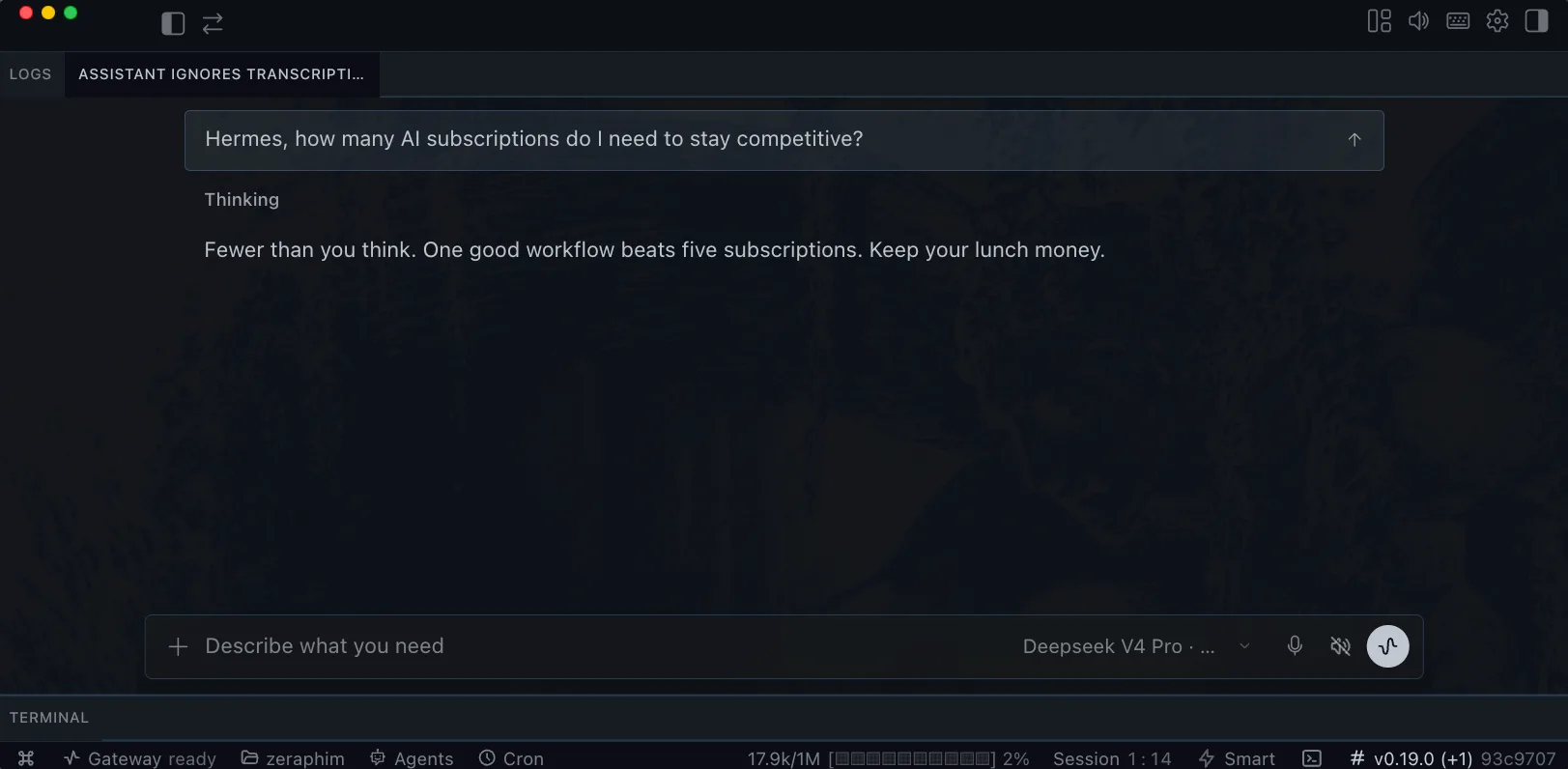
"Should we Filipinos train our own models?"
That question is why I joined SapinSapin AI.
We have always been great at using technology. Filipino internet users spend about 36 hours a week on social media and online video, more than any other country surveyed and nearly double the worldwide average, according to DataReportal's Digital 2027 report (GWI survey, mid-2026).
We use AI too, but we are not leading. Microsoft's usage data puts the Philippines 56th of 147 countries in early 2026, and Google's e-Conomy SEA 2026 report ranks us last of six Southeast Asian markets for AI adoption. And very little of that AI was built for how we speak. When OpenAI trained Whisper, one of the most widely used speech recognition models, it had 75 hours of Tagalog audio against more than 438,000 hours of English, according to its own paper.
So we use it. Are we actually making one?
What we built
This is the first demo of SapinSapin voice. I speak Filipino, and the words appear on screen while I am still talking. In the video I recite the Panatang Makabayan, the pledge most of us recited in school. The first words show up between 0.6 and 2 seconds after I start speaking, measured in the browser, including the trip to our server.
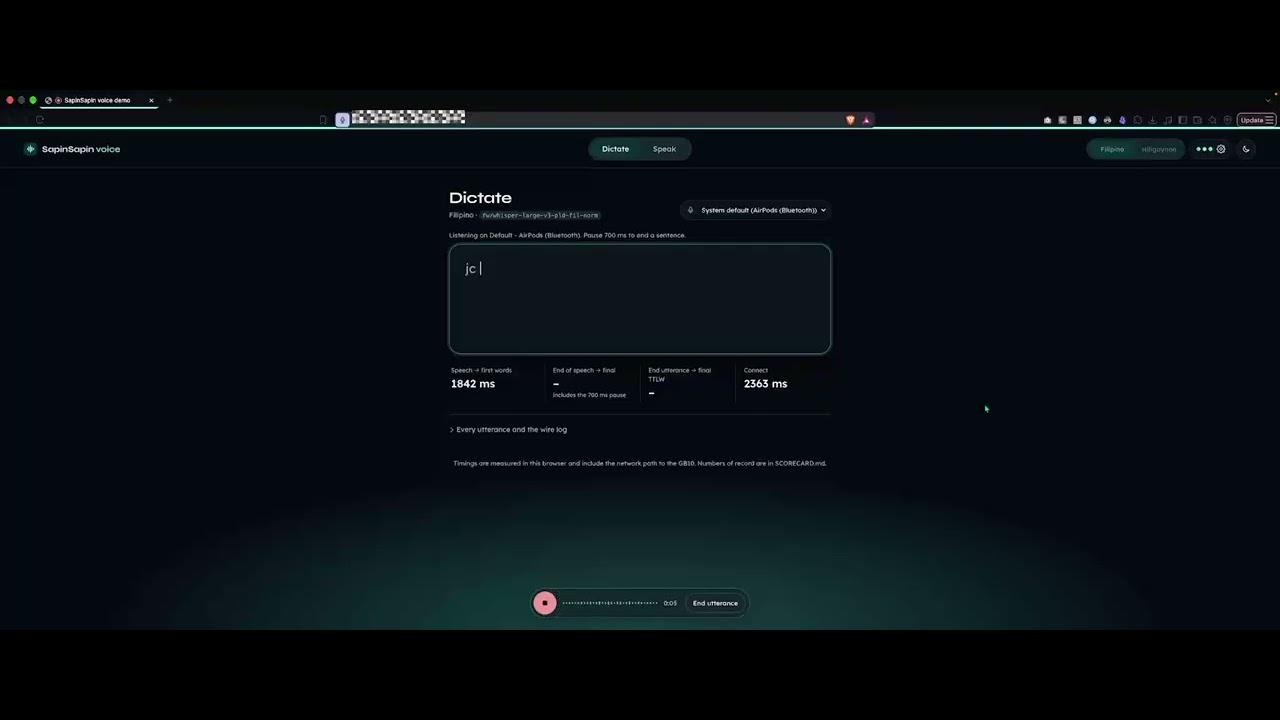
SapinSapin Voice Demo
The model behind it is our fine-tuned version of OpenAI's Whisper large-v3, trained on Filipino speech. On the full held-out Filipino test set, it gets 12.24% of words wrong, roughly one word in eight.
One in eight is not perfect. I know. Watch the second take closely: where the pledge says "kinukupkop ako," the model wrote "kinukop ko pa ko." It still misses a line almost every Filipino learned as a kid. That miss is the reason this post exists. A foreign lab has little reason to fix it. A community of native speakers can.
How we trained it
The model was the easy part. The data took most of the work.
We trained on sapinsapin/pld, a speech dataset covering 10 Philippine languages: 334,000 recordings and 448 hours of audio. It is badly lopsided. Bikol has 95.8 hours. Tausug has 5.9.
My first lesson came from an earlier corpus. In my running post, in the section on why this is the best time to start, I wrote about the Filipino speech dataset that looked ready and was not: 56% of it was isolated single words, and the same speakers appeared in both training and testing. Filtering took it from 305,246 segments to 4,857 usable sentences, and my first fine-tune took word error from 52.58% to 31.02%.
We carried those checks into the bigger model:
Split by speaker. Nobody in the test set is heard during training, so the score measures new voices, not memorized ones.
Drop rows that only look like data. Some recordings come with the prompt the speaker was asked, not what they actually said. Those stay out of training.
Serve it to stream. I converted the model to faster-whisper, a faster engine for Whisper, and built the streaming server on a shared NVIDIA GB10 machine, so words arrive while you talk instead of after you finish.
The same week, a Hiligaynon speech recognition model went live on the same server, next to text-to-speech voices for Filipino, Cebuano, and Hiligaynon. The video only shows Filipino dictation. The rest is next.
None of this is one person's work. Tim Santos leads the initiative, Marc Ocampo built the website that got the community started, and a handful of volunteers train, crawl, and clean data on weekends.
Why it needs more Filipinos
The Komisyon sa Wikang Filipino counts about 135 native languages in the Philippines and lists 40 of them as endangered. If Tagalog got 75 hours in one of the world's biggest speech datasets, imagine what Tausug, Ivatan, or Chavacano got. Even our own dataset, the second chart above, covers only 9 Philippine languages, and two of them have less than 9 hours each.
Our team cannot fix that alone, and the reason is not compute. We cannot judge whether a Hiligaynon clip is clean or a Waray transcript is correct if none of us speaks Hiligaynon or Waray. Every model we train is only as honest as the people who check its data, and right now there are not enough of us checking.
That is the bottleneck: native speakers who can listen to a clip and say "tama" or "mali."
How to help
You do not need a GPU or a machine learning background for most of this.
Open sapinsapin.ai. The open-source projects, models, and datasets are listed there, with links to our Hugging Face and GitHub.
Join the Discord and say what you can do. We need help training speech recognition and text-to-speech models, collecting datasets, cleaning data, and annotating speech.
If you speak a Philippine language well, tell us which one. We need native speakers to review recordings and build datasets. If your language is dying, we want to help record it while there are still people who speak it.
Share this with one person who speaks a language we have not covered yet.
We already spend more time on social media than anyone in the world. The AI that understands our languages should be built by Filipinos, not just used by them.